
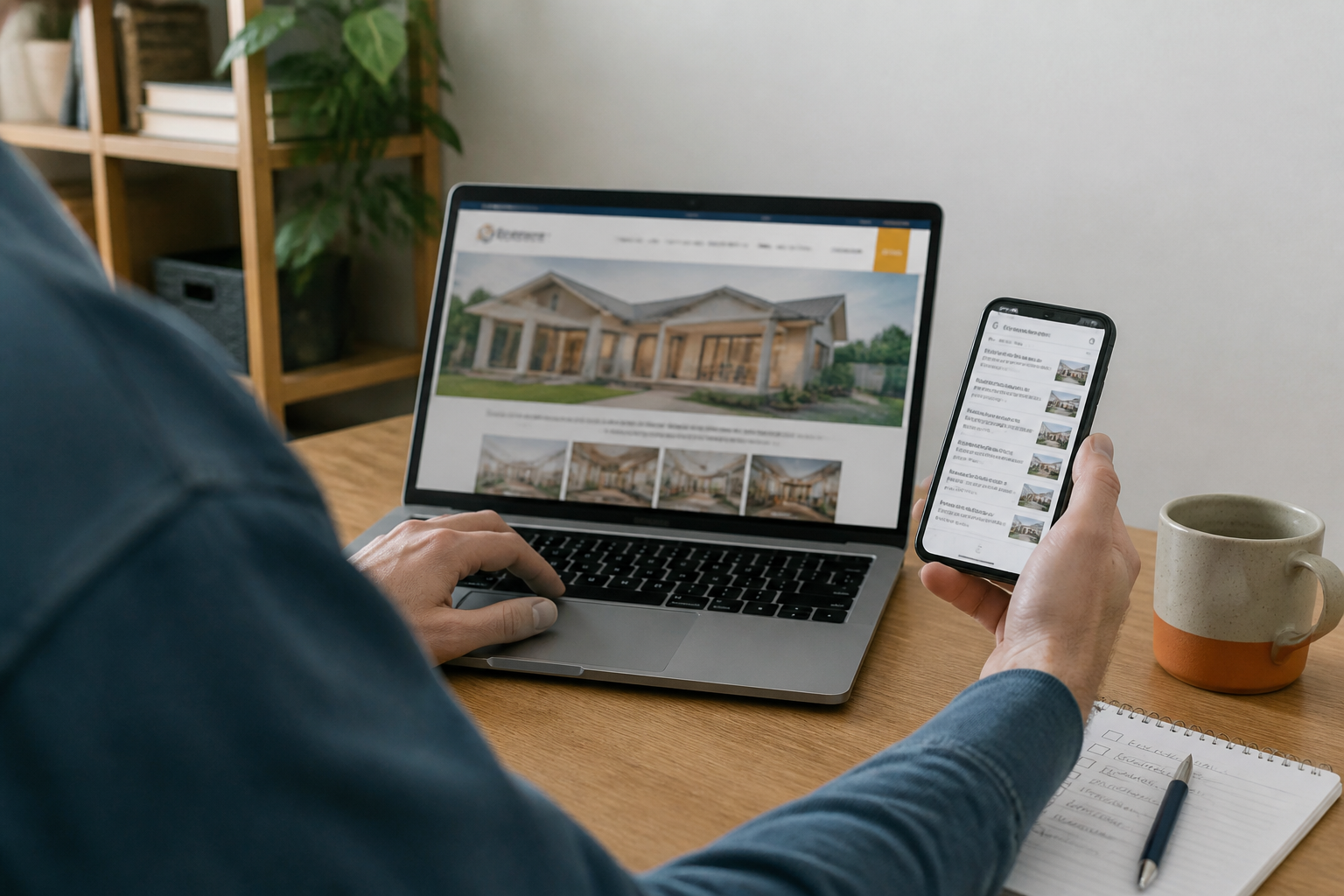
A builder website is easier to find when it clearly explains what the business does, where it works, who it helps and why its claims can be trusted. Search visibility starts with useful, crawlable pages and consistent real-world business information—not a stream of generic posts written only to target keywords.
Use this self-check to identify the obvious gaps. It is a practical marketing resource for builders, not a promise of rankings. Search results vary by query, location, competition, website quality and factors outside the builder’s control.
The quick answer
- Make services and service areas unmistakable.
- Give important services their own useful pages.
- Show genuine projects, people, credentials and client proof.
- Answer the questions clients ask before enquiring.
- Connect pages with descriptive internal links.
- Keep the site crawlable, measurable and current.
1. Can a visitor understand the business in ten seconds?
The homepage should identify the type of builder, the main project types and the genuine service area in plain language. “Quality construction†does not tell a client whether the business builds custom homes, extensions or bathrooms—or whether it works in their area.
- Is the business type clear?
- Are the main services named?
- Is the real service area stated naturally?
- Is there a clear next step for a suitable enquiry?
2. Does each important service have enough information?
A useful service page should help a prospective client decide whether the service fits before they make contact. Explain the type of work, likely client, process, boundaries, information needed, relevant proof and next step. Do not create dozens of near-identical suburb pages with only the place name changed.
Use one clear page topic and one descriptive main heading. Titles and descriptions should accurately summarise the page for a person choosing between search results.
3. Is the location information accurate and consistent?
State only the areas the business genuinely serves. Keep the business name, contact details, website and service-area information consistent across the website and Google Business Profile. Complete the profile accurately and keep appropriate photos, services and opening details current.
Google explains that local results are mainly based on relevance, distance and how prominent a business is. No one can guarantee a particular local position. See Google’s own guidance on improving local ranking.
4. Does the website show real proof?
Useful proof is specific and attributable. It may include completed-project photography, project type and location, the people behind the business, relevant licences or qualifications, association memberships where applicable, and genuine client feedback used with permission.
- Use real work rather than generic stock imagery wherever possible.
- Explain what the project involved, not only that it looked good.
- Do not invent testimonials, locations, credentials or project outcomes.
- Make it easy to understand who is responsible for the content and the business.
5. Does the site answer real client questions?
Start with questions that appear in actual enquiries and preconstruction conversations. Useful topics may include what information is needed for a quote, which projects fit, how the builder’s process works, how selections and variations are handled, what affects timing and what the client should prepare.
Answer the question directly, then add the context a client needs to act. Google’s people-first guidance asks whether content serves an existing audience and demonstrates first-hand expertise; that is a better editorial test than writing to an arbitrary word count. See Google’s guidance on helpful, reliable content.
6. Can search engines and people move between the pages?
Important pages should be reachable through ordinary links from navigation, the footer, service pages or relevant articles. Use link text that describes the destination. A renovation article might link to the renovation service, a related project and the enquiry process—not simply say “click hereâ€.
- Give each main page one clear purpose.
- Link related pages where the connection helps the reader.
- Repair broken links and unnecessary redirect chains.
- Keep important content in readable page text rather than only inside images.
- Use descriptive alternative text when an image adds information.
7. Is the technical foundation visible and measurable?
A specialist may need to check the technical details, but a builder should be able to confirm the basics:
- the preferred website version uses secure HTTPS;
- important pages are not accidentally marked noindex;
- the XML sitemap loads and is submitted in Google Search Console;
- Search Console can report indexing and search-performance data;
- analytics records meaningful enquiries or form completions where consent and privacy requirements are handled; and
- mobile pages remain readable and usable.
Do not judge the program only by total traffic. Track whether suitable service pages are indexed, which relevant queries and pages earn impressions, whether branded visibility is healthy and whether qualified enquiries improve.
A practical priority example
A renovation builder with a vague homepage, no renovation service page and ten generic blog posts should not begin by producing another ten posts. Clarify the homepage, build the useful service page, add genuine project proof, connect the pages and confirm measurement first. New articles can then answer related client questions and support that service.
Builder website findability checklist
- The homepage identifies the builder type, services and genuine service area.
- Each priority service has a useful, distinct page.
- Business details are consistent with Google Business Profile.
- Real projects, people and credentials support important claims.
- Content answers questions actual clients ask.
- Titles and headings accurately describe each page.
- Descriptive internal links connect relevant services, proof and guidance.
- Important pages are indexable and included in the sitemap.
- Search Console and enquiry measurement are working.
- Someone is responsible for reviewing accuracy and performance.
Know when the website needs specialist help
This checklist can expose obvious content and structure gaps. Technical crawling problems, migrations, domain changes, structured-data faults, significant traffic losses, complex local-search issues and analytics configuration may need an experienced website, SEO or measurement specialist.
Ground Floor’s core role is builder-business systems and coaching, not acting as a specialist SEO agency. This resource exists because clear marketing information and a controlled enquiry path are part of a workable building business.
Related builder resources
- What Should a New Builder Systemise First?
- Builder business coaching and systems support
- The First 5 Systems Every New Builder Needs
Is the enquiry path only one part of a messier workflow?
If enquiries, quoting, job information and follow-up do not connect cleanly, tell Ground Floor what is currently difficult to control. Each enquiry is reviewed before a next step is suggested.